

This contrast is even more apparent in Beune, a small city about five miles outside of Dijon which I visited on Tuesday of this week.. The largest main historical landmark in Beune is L’Hôtel Dieu (God’s hospital). Constructed by Nicolas Rolin, a priest and chancellor to Phillip the Good in 1443, the hospital was built as a refuge for impoverished sick people. The building has a distinct aesthetic in and of itself. The main room's ceiling is built to look like the bilge of a boat, and the wood is carved to resemble the faces of men and animals, each of which represents some sort of trait or character flaw. Every face is unique, and the animal carved next to it correlates with that person's sin. A pig, for example, represents lust. Inspired by Noah's arc, the ceiling was meant to bring joy to the sick people, many of whom would die in their beds, with some form of entertainment and hope of renewal.
 |
| The outside of God's Hospital. The tiles on the roof all have symbolic significance. The red symbolizes wine, which is Beune's main crop. The brown symbolizes the earth, and the green symbolizes nature. The yellow is a color associated with Burgundy itself. |
 |
| The ceiling in the main room. |
The chapel at the end of the hall stands underneath an immense strained glass window. In addition, the walls are painted red and inscribed with the word "seule" (alone) in golden letters. Diagonal to the word is an image of bird on a branch, which our guide told us represents death. Next to it is a symbol that I didn't recognize, and star sits beneath the branch on which the bird is perched. The star represents the good or the divine, and the strange symbol stands for love and faith. In other words, the wall can be loosely interperated as In the presence of death, love and faith alone are good.

 |
| Murals in St. Hugues' room. |
The final room I visited in the hospital housed the original version of Rogier van der Wayden's "The Last Judgement." Different sections of the painting are opened and closed depending on the time in the church calendar. It shows the dead rising and being judged by St. Michael, whose face is disinterested and impartial. The good go off to the left into the shining gates of heaven. The evil go off to the right into fire.
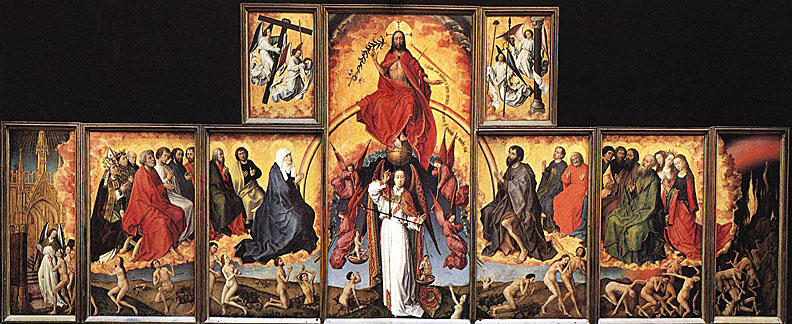 |
| The sword at Jesus' left hand symbolizes justice. Notice Saint Michael's detached gaze. The sinners who are going off to hell on the right are depicted eating their own hands, showing the self destructive nature of sin, and pulling others into the pit to share in eternal anguish. |
The people who live in Burgundy accept their buildings, art, and attitude as a way of life. The same could be said for Americans as well. I make no value judgments on either attitude; I'm well aware that they both have their shortcomings and their merits. Instead, I wish to express how the attitude of a people can seep even into the buildings in which they live.


No comments:
Post a Comment