Thursday, December 29, 2011

Meditation #2 (For the New Year)

December Dirge

This month seems to deny its age--like an old, white-faced dog that, despite its cracking arthritic joints and cataract-cloaked eyes, insists on chasing the trucks that putter down the streets.  I guess its warm in other places too this year, and I admit that its an odd and even unwelcome sensation when I move about outside knowing the water that creeps into the mesh cloth of my shoes is from rain puddles instead of snow drifts.

Of course, even as the year refuses to let winter's bony fingers stretch over it, most everyone else seems to welcome its end, seems eager to celebrate its death, or rather what they perceive as its death, and wretch the new year out into what will surely be a cold January.  I suppose it's natural for everyone to welcome new changes and new beginnings on their own terms.  It's understandable to want to escape from the regrets, indecision, heartaches that strode through 2011, whether they be personal or broad in scope.

I'm hardly an exception to this ritual.  In the past, I've welcomed new changes and new opportunities.  It's nice to get a fresh start every once and a while.

Yet, time is weary for the impatience of those who try to bottle it.  Events and their memory cannot be scraped from the mind like one scrapes frost from a windshield.  And now, in the 22nd year of my tiny little corner of perception, I am less eager to escape the past twelve months.  Though, I'm in no hurry to try and relive them either.  

I'm pleased with myself that I'm finally finding it easier to accept the events of my life with tranquility and not waste time in a fruitless quest to forget or ignore.  Try as I might to forget this year, it certainly isn't going to forget me.  

Happy New Year.

Sunday, December 11, 2011

Classes in Dijon vs. Classes in Columbus

How many of you can guess which nations have the best universities?  Usually when I think of the higher education, I think of the long European intellectual tradition, the tradition that gave us Sartre and Kant and Newton.  It makes sense that the best universities are to be found in European nations, right?

Well... that's only partially true.  US News and World Report in their annual university ranking survey ranks the United Kingdom, having four schools in the top ten, and the United States, having six schools in the top ten, as the best countries in which to seek higher education.

The rest of the list is dominated by both the UK and the USA, which, as you can see based on my assumptions, surprised me.  I think that there's a stereotype among Americans that European universities are prestigious and glamorous, but evidently, the data suggests that if you want to get a good education, it's better just to stay in the States.

In fact, my adviser from the Office of International Affairs at Ohio State told me before I left that most French universities "sucked."  I was skeptical of her assertion; I'm not one to take things on here-say, but the research seems to confirm her idea.  France is on US News' list only a handful of times, and lists from different sources show a similar trend.

At the University of Burgundy, I actually don't take classes in the university proper.  I take classes in a program called the CIEF (Centre pour des Edutiants Internationaux de Francais), which is a special program designed specifically for international students who want to learn French.  My class time is split up between language classes, where they simply teach us the raw basics of French, a civilization class about the basics of French history and politics, and culture classes which teach more specific subject areas like economics, literature, and philosophy.

I wonder how much of my experience here is the result of the structure of the CIEF, as opposed to the general university system itself, because much of it is set up very differently from the United States.  Firstly, I'm noticing a much larger focus on classroom rapport and accountability.  At OSU, there are numerous classes in which the teachers never take attendance and in which in the only grades are the exams.  Here, there is homework almost every day, and the teachers grade every aspect of your work, from grammar to expression to handwriting, even if the assignment has nothing to do with these things.

That being said, the work load is actually quite a good deal less than that of my classes in the States.  There are no long reading assignments, and most of the homework is in the form of worksheets that can be completed in a hour or two.  The teachers ensure that the students learn by grading hard and monitoring our progress closely.  In the US, the teachers expect us to take responsibility for ourselves and be disciplined in keeping up without prompting.  I've frequently heard professors at OSU say, "You're adults now.  It's your job to make sure you do well."

This is hardly the attitude here.  One must keep in mind that a much larger percentage of the American population goes to college than the population in France.  There's less of an emphasis here on university being the primary medium for ensuring the well-being of one's future.  As a result, American universities take in more students with a wider range of abilities, and I think that the American university would benefit if its teachers were to suddenly decide to grade harder and scrutinize mistakes.  I think that this would ensure a greater accountability from the students.

Still, the amount of busy work and the hovering over shoulders in France is off putting.  There are days when I feel like I'm back in high school.  Two weeks ago, one of my professors noticed the way I was taking notes in her class and proceeded to harangue me about bad study habits.

I admit that I took it a little personally.  I don't think that many people would find me unreasonable if I were to say that it's none of her goddamned business the way I take notes,  all of which were completely in French and have served me rather well in the past, thank you very much.  Of course, after I calmed down, I realized that there no way of her knowing that I found them effective.  Yet, the fact that she felt the need to monitor my habits lingers in my mind as needlessly invasive, and based on what I've heard about other teachers this attitude about monitoring our progress is pretty pervasive.

I'm also finding the teaching style to be more disjointed and less focused than in the US.  It's not uncommon for teacher to go off on tangents and jump around between subjects.  The culture classes, which are all lectures, are sometimes difficult to follow and discussion of the ideas being presented, that is asking questions of the students or asking for input, is rare.  That's not to say that there aren't teachers who ask for discussion or encourage us to question.  However, these things are such prominent parts of American educational pedagogy, that their relative absence is bizarre.  Even if a subject itself is interesting, a course can make it boring or difficult to understand without active participation from the students, and if there's something that I don't understand in a class, it's never because of the language barrier.

Again, I wonder if this is due to the French university system itself, or if it's the result of the CIEF.  I imagine that a lot of the classes are deliberately slowed down in hopes of accommodating for language skills. I've been tempted to sneak into a lecture hall during one of the regular classes and observe to see if it's any different.

I'm not trying to sound ungrateful.  I've learned a lot during my time here, and my language skills have improved.  Still, the classes here aren't nearly as rigorous as the ones at OSU, and I wish more than anything that the teachers would give us a little credit.

Sunday, December 4, 2011

On Post-Nationalism and Globalization

In the movie Network, there's a great scene where Beale, a disenfranchised news anchor who's been able to turn his angst into a Glenn Beck-like political commentary show, is given a speech by one of the corporate executives (played by Ned Beatty) who owns the news network.

"You are an old man who thinks in terms of nations and peoples.  There are no nations.  There are no peoples.  There are no Russians.  There are no Arabs.  There is no West."  He continues, "We no longer live in a world of nations and ideologies...Our children will live in that perfect world where there is no war nor famine, oppression or brutality."

Despite the promises that the executive makes, many people find the prospect of the world being run by nebulous corporate entities rather frightening.  In the end, the movie is hardly optimistic, and other mediums have expressed this worry as well, from books to music, and even video games.

In Deus Ex: Human Revolution for the PS3 and Xbox 360, the main character fights against  a vast corporate conspiracy.

In the late David Foster Wallace's novel, people's lives are dominated by distraction and entertainment from corporate entities.


In Pink Floyd's tenth album Animals, they compare the corrosive effects of capitalism and despotic political rule to various animals, notably business men being likened to dogs.
I've talked before about the effects of globalization on my experience here in France.  With the presence of the internet and the ease with which people can travel and access information nowadays, old concepts of nation-hood, human identity, and political relationships are collapsing and being replaced with something new.

Economics is one of the ways that this transition is being facilitated, specifically corporate capitalist economics.  I've worked on trying to understand economics better lately, but, given my background, I can understand why people would not find me the most credible source on this issue.  Luckily, what I'm going to talk about doesn't really relate to raw economic and commercial theory.

Usually when I hear people criticize transition and change as the result of globalization, it's often in the form of cliched and inarticulate rants about "the corporations, man," but I think that there are some legitimate concerns about the effects globalization, or rather coporatization, has on peoples lives.

One thing that bothers people about this prospect of corporate power is the effect that it can potentially have on the emotions.  Businesses are profit driven, so they try and cater their strategies to people who feel that they must have something that they may or may not necessarily need.  David Foster Wallace talks about this in both his book and in interviews.  Businesses exploit people's unhappiness by offering products and services that will temporarily slake their emptiness.  This, in turn, stokes an endless feeling of unsatisfaction which can only be quelled by buying more shit.  This is sales 101: create an atmosphere in which your potential customer feels that he will regret not buying what you're trying to sell, and the ideas above are just a huge expansion upon that principle.  While this is very good for stimulating economic growth and material prosperity, it doesn't address deep-seeded emotional needs and can arguably contribute to feelings of emptiness and isolation.

Overall, I've found France to be much less consumerist than United States, with the exception of Paris, but international economic interests are still present.  Another aspect of globalization that frightens people is the idea of homogeneity,  that everything in life will be turned into one monochromatic parade of mass-produced simplicity that, again, works to serve the profit motive.  Anyone who has access to as much as a newspaper stand will tell you that people are pissed off by  corporate powers.  The biggest example is the Occupy movements happening in the United States, though their grievances extend to other things as well.

These are a couple of the legitimate problems, though there are certainly more, posed by mass, consumer culture that need to be addressed.  Other, more vocal criticisms aren't so well founded.  There is a difference between corporate interests using lobbying and donations to push their agenda, and the existence a shadowy capitalist conspiracy that has its fingers in everything.  I've found that conspiracy theories never hold up under scrutiny.

Furthermore, there are things that foster globalization besides economics.  Communication, namely the internet, has breached borders in every area from politics to arts to science.

For whatever the reasons, Earth seems to be entering into what optimistic thinkers, like Michio Kaku, call a type 1 civilization, or a planetary civilization.  This civilization is defined by planetary unity, in which politics are not dominated by national interests, but rather by more collective interests.  If I were to speculate about the far future of this sort of civilization, I could imagine a universal language, a universal currency, and even singular government system.

Evidence for this transition is everywhere.  There haven't been any large-scale wars between nation states in many years,countries crowd themselves into trade agreements like the EU and NAFTA in order to better compete, English is becoming a common language everywhere, including even places like China where students are required six years of it before even entering high school, and I can pull up my computer and speak to someone who lives half-way around the world and to whom I've never spoken right now I wanted.

At the same time, one must consider that perhaps this transition will be slow or not happen at all.  Turmoil in the EU is the biggest illustration of the possibility.  Whereas I was quite convinced in an earlier post that Europe would seek to strengthen their economic bonds, a lot of the research I've done is predicting disintegration rather than federalization.  More locally, NAFTA has been criticized by thinkers on both the left and the right as ineffective.

Furthermore, there's no way of knowing that English will become a universal language or if there will even be one.  Common languages in the sciences and in trade have existed for a long time, notably Latin and Greek for about five hundred years, but these were reserved to only select spheres of people.  Most others functioned only on the vernacular of their own context, and I think that for the most part, especially in parts of the world with poor education, this is still the case.

In addition, the internet, which has frequently been hailed as the great communication bridge, may in fact be doing more to split us into teams than unifying us.  Algorithms on both social networking sites and search engines base what they put up on screen on prior interests and keystrokes.  You can try it right now.  Pick a keyword and type it into a Google search bar.  Then, go to a someone else's computer that you don't use ever and type in the exact same keyword.  I can guarantee that the results will be completely different because the internet tracks the users' past activity and filters its results based on that.  This aspect of the internet may serve to only confirm old prejudices and biases and make us more separated ideologically.

The criticisms are varied and many, but still the biggest hitch into a post-national world is identity.  National and regional origin is still such a determining factor in how people see themselves, and, in reality, who they are.  If there is anything that living in a foreign context has taught me, it's that so much of my own identity has been determined by where I've come from and where I've been.  It's not easy to dislodge that the role that place plays in people's lives.

Yet despite all these reasons, I think I'll repeat myself again and say that this is the period of transition.  It's difficult to know the future of politics, economics, and identity at this moment.  Large scale changes don't always translate down into the details of an individual person's life.  I doubt that mankind will be unified within my lifetime, but I remain convinced that the aspects of modern life are breaking up the paradigms of what used to dominate mankind.  At some point in the future,  in the far far future, whether someone or something is American or French or whatever will not only be thought of as irrelevant.  In truth, it won't even be part of the conversation.  With this sentiment come news sorts of progress and... new sorts of problems.

Tuesday, November 29, 2011

Immersion Continued

Apologies, apologies, the interwebs were not cooperating, and I'm only just now publishing this post.  I wrote it three days ago, it's not my fault.

This week was rather uneventful, in fact, I've been struggling up to this point to find something to write about.  But after sitting around in my room for most of the equally uneventful weekend, I think I will bring about an update on my language skills.  Are you read to be blasted to an ashy cinder by the bright, shining truth that you thought you wanted?

Things are getting better.  Or at least, I'm less bothered by my insufficiency than I was at the beginning of the trip.  There are still the people who revert to English when I try to speak to them, there are still instances when I need to tell people to slow down, and there are still the unexpected telephone calls in the middle of the night from some French-speaking man who is repeatedly surprised that there are no women living in my room and who always says "Sweet dreams" after I say, "Please stop calling me," but that's a different topic entirely.

I'm finding that I can read a French document or go long passages in the French novel that I own without using a dictionary, and I can have brief conversations with people on the street if they try to speak to me.  I even made a French friend who came to eat dinner with some friends of mine and me.

From left to right: Nina Ni, Xiaoyan Le, Sika Minglu Zhu, myself, Anastasia Sarandi, Annabelle Marcouyoux
Still, familiar French is rather difficult to penetrate (heh).  It's like its own language in and of itself, and it makes  American idiom and slang look shallow by comparison.  Furthermore, I'm finding that it's not always so easy to gauge when its use is apporpriate.  I went to by some train tickets earlier this week, and the woman who helped me, despite being dressed in full, formal business attire and sitting behind a very well kept and organized desk, laced her speech with all sorts of familiar phrasing that I was rendered speechless.  

Luckily, though, my civilization class devotes a full hour of its weekly four hour duration to the use of familiar French.  We learned some common idiomatic phrases.  Some of the most interesting are listed below, first in the original French, followed by their literal English translation, followed by the idea they wish to express:


"Etre soupe au lait"--to be milk soup--to have an inconsistent mood
"Enculer les mouches"--to fuck the flies-- to have nothing to do
"Peigner la girafe"--to comb the giraffe-- to have nothing to do (less vulgar)
"Avoir un coeur d'arichaut"--to have an artichoke heart-- to be too sensible or cautious
"Une fleur bleue"--a blue flower--someone who is naive
"Tremper son biscuit"--to dip his/her cookie-- to make love
"Jeter le bebe avec l'eau du bain"-- to throw the baby out with the bath water-- to avoid an important topic or issue
"Vingt-deux"--twenty two-- here comes the boss
"Bon vent!"-- good wind-- Get lost!
"Avoir une araignee au plafond"-- to have a spider on the ceiling-- to be crazy, nutsy coo-coo

I learned others, but I think that's a good enough amount for now.  I think there some interesting parallels with English idiomatic phrases as well.  The last one, avoir une araignee au plafond, reminds me of the English phrase, "The lights are on, but nobody's home."  It has a similar image and conveys a similar meaning.  There are even some phrases that are exactly the same in both languages like "une pierre qui roule n'amasse pas mousse," or "a rolling stone gathers no moss."  

Fun facts aside, I still have a long way to go, but I feel like I'm making some progress for the first time since I've been here.

Monday, November 21, 2011

On the Euro Crisis

So much pain!
There has been a whole mess of talk about the Euro and its viability in the wake of several debt crises in the Eurozone.  In short, several countries who are part of the European Union, namely Greece and Italy, have suffered under the pressure to keep up with the currency.  Under the euro, nations like these have struggled to thrive under increasing debt, and as a result businesses and economies have suffered.  Italy just recently passed a set of austerity measures in hopes of maintaining economic stability in the future.  This is a brief description of the events surrounding the euro debate.  CNN has a more detailed summary of the crisis, which you can read here.

Firstly, let me point out that I really don't understand economics.  Once during my economics class last year, I approached the professor with a question about... capital or demand or GDP or something economicy like that.  He proceeded to explain the concept.  I didn't understand, so he tried explaining it another way that I also did not understand... and another way, and another way,... and yet another.  Finally, he put down his pencil and mumbled, "Well, you don't need to answer every question correctly on the test in order to pass."

What I do understand is cause and effect, and I'm pretty good at reading cultural and social phenomena, both of which are influenced by economics.  So, I will focus on shedding light on those things, as well as offering some thoughts into how people are debating them.

As I've mentioned before, the Europeans are good at debating, and even in the wake of some very real problems and threats, they manage to stay relatively calm.  I'm afraid I can't say this about the media in the United States.  Though, like I said, there are many potentially destructive consequences to this crisis, many American news emissions, like this one which is also from CNN, seem to revel in the unfortunate nature of the events.  I've read other American articles that could easily be headlined as "Watch Europe Burn!"   

But let us not dwell too long on the American entertainment--err, I mean news-- networks' portrayal of the situation.  The primary concern is that European Union will be fractured into what the French newspapers are calling a "Europe a deux vitesses" or "two-speed Europe."  This entails a couple of different outcomes.  It could mean that the struggling nations leave the European Union, or it could mean that they stay in the European Union but revert back to their prior currencies.  In either case, it would cause a divide in the Eurozone wherein the wealthier nations continue to be wealthy and build their economies with a more powerful currency while the others fall even farther behind.  Hence the "two-speed" distinction. 

I'm guessing that this probably won't happen.  Europe's leaders have tried so hard to maintain economic unity that to suddenly go back on it would make everything worse, as detailed in this article here (it's in French, but if you have Google Chrome then the browser with translate it for you).  I think that this is further evidenced with Italy's recent austerity bill; governments do not want the European Union to fail.  To further stave off more problems, some have even proposed bail outs from Germany and France, the two most wealthy Eurozone nations.

Yet, the most interesting reaction by far is the push for greater federalization of economic policies.  Some thinkers, like this guy (again, in French), think that this the perfect opportunity to further integrate European nations into one economic entity.  This would give more power to European Commission to dictate economic policy and reduce the power of individual nation states to act outside of the Union's economic interest.   The logic here is that in order for the Union to work, there needs to be more uniformity and enforcement of the Union's policies, as opposed to now wherein some member nations go well above the maximum debt amount and get away with it.  Several high ranking officials have already expressed support for this idea

I curious to see how this will play out.  With the desire to maintain unity, it's not unrealistic to think that European economic policy could become truly federalized, that there would in fact be one economy for the European Union.  From what I've read, this would be maintained by the European Central Bank, though I'm still hazy on the details of how that would work.

I imagine that I could offer more insight if I was knowledgeable in economics, and it's sometimes difficult to follow these events in France where everything is hunky dory, at least relatively.  As always, if you find something inaccurate or lacking in the post, please let me know.  I like being informed.

I enjoy learning about history, and I'll admit that I do have a habit of dwelling on the past.  Still, it's never been in my nature to be nostalgic.  I think that it's an interesting time to be alive because I believe the world is in the middle of transitioning from one state of affairs to another.  Like when national sovereignty replaced feudalism, the nation-state is giving way to a new socioeconomic and political entity.  Perhaps this will take the form of federalized nation groups, or perhaps it will be something else.  In any case, I suppose it's too early to speculate, but I'm glad to be part of the conversation. 


Sunday, November 13, 2011

First Meditation (or, Pretentious Rant #1)


I hear that the fog comes every year.  The autumn swims in it.  It moves in during the morning, and if the sun is behind the clouds all day, it lingers until the early evening.  It's a heavy mist that you can see and touch, not the patchy, thin, easy to ignore fog that sulks about the fields of southern Ohio like little bands of disinterested ghosts.  No, this fog saturates everything.  If I go outside during the day, my shoes and feet are always wet by the time I go back inside.

I imagine what this is like in the more rural parts of Burgundy.  The city, with its noise and its lights, has a way of keeping me numb to the more natural aspects of the place around me.  I picture myself alone outside in a field.  There's no noise of cars honking or people yammering about trivial, everyday things.  There's me and the grass... and the fog.  It envelops everything, and when I walk forward, it seems to follow me, like I could go on forever and never see anything else.

Every year it's like this.  Grendel is referred to in Beowulf as "mist-walker."  The impulse to imagine something horrible and threatening in the fog is all too seductive.  I look out at it the same way I look into a pitch dark room.  I know better, but still the thought creeps in,  who knows what sorts of monstrosities nature's coughed up to haunt the veiled landscape?  No wonder people crowded themselves into towns and halls, if only not to have to be reminded of the mist.  

This is the edge of the northland, away from the arid summers of Greece, and the bright springs of Rome.  The boundary marked by the fog tells that this is beginning of where the hairy-faced barbarians of old roamed and lurked about.   Who could stand to live here?  What would those people be like?  

An outsider like myself thinks of these things, but someone who is from here would probably ask the same questions of any place that was strange to them.  Imagine living in this all your life, then being transported to Mexico or Brazil, the stifling heat, the sun so bright all the time it seems to drum on your brain.

Even the weather seems to plays into people's identity and perspective, and I wonder how it has shaped my own.


Sunday, November 6, 2011

The Frustration of Immersion (and Lack Thereof)

I remember talking with one of my professors before I came to France.

He gave me this advice, "When you go to France, convince yourself that you are bad at French."
Well, I thought that wouldn't be too hard.  I had some vague idea that speaking a foreign language in a foreign country would be a little difficult.

He continued, "When you are speaking in France, be patient with yourself.  Don't worry about if you make mistakes, just make sure that people understand what you are saying."

Unfortunately for me, I underestimated just how easy it would be to convince myself that I was bad at French.  My first conversation, or rather attempted conversation, in French was with an SNCF, the nationalized French train service, worker at the airport.  I approached his desk and politely asked for a train ticket to Dijon in French.  He understood me just fine, but I wasn't prepared for was his response.  Rolling out of his mouth came a barrage of completely unintelligible French phrases.  So unintelligible, in fact, that I was stunned speechless.  Noticing this, he asked me in English the same question he was trying to convey in French, quite simply, "Have you ever traveled with SNCF before?"

Over a month into the program now, and I feel like this is still happening too often.  A French speaker will say something in French that I should recognize but can't, and I have to ask them to repeat what they said a second, third, or fourth time.  What's even more frustrating is the fact that they will often switch to English when they see that I'm having trouble.

As frustrating as immersion is, what's even more irksome is the difficulty I'm having in getting immersed.  Everyone speaks English, and this is the common language of most of the students in the International Residence, many of whom have never taken a French class before this semester.  Even those who have taken French classes before are often more comfortable speaking in English; some of them will even become annoyed when you try to speak French with them.

I'm not trying to give you a bad impression of the other students.  For every student that insists on speaking in English, there is one who will gladly speak French with you, yet I can't help but feel that I'd be making more progress if I was totally immersed all the time.  Of course, I imagine that if I was totally immersed, my experience here would be much more exhausting and lonely.

I'm continuing to seek out new opportunities to get immersed. I've joined two martial arts clubs here, both of which are conducted entirely in French.  I've started reading a novel in French, and I try to listen to French radio programs at night before I go to bed.  Even with these improvements though, the anglophone speakers are always around the corner, and I realize now that I was as unprepared for them as I was for the francophone speakers.

Sunday, October 30, 2011

Tourist Town


I suppose the last thing that you want to hear is me bitch about commercialism again, but I feel that this idea bears further examination.

This weekend, my study abroad group, a couple friends we met at the residence, and I went to Paris for the weekend to be tourists.  This visit was great, but the atmosphere of the whole city made me feel a little uneasy.

Let me start at the beginning...

According to the French Government, which has it own section dedicated to tourism, France is the most visited country in the world, bringing about 82 million tourists a year (reported in June of 2008).  Without argument, the place that receives the most tourism within France is Paris, the grand capital city.

I knew this going into Paris, but I didn't realize just how much the tourism affected the city's pulse.  Travelers are everywhere, from all over the world.  Walking down the street it wasn't uncommon to hear  four or five different conversations all occurring in four or five different languages.  And the city transit maps have big diagrams showing where the famous tourist sites are.

This section of a bus map, for example, shows the location of both the Notre Dame Cathedral and the Chatelet des Halles.


I suppose this is to be expected, but everywhere we went, the city seemed to be a giant machine catering to tourists.  There's the stereotype that Parisians are rude, but I didn't experience this when I was there.  In fact, the townies were more than happy to let tourists in on everything.  At Notre-Dame, tourists were allowed into the chapel in the middle of mass.  There were signs hung about which told everyone to be silent during the ceremonies.  No one was, of course, and during the processions and readings there was a steady din of conversation undulating around the congregation.


This would be very difficult for me to tolerate if I lived here.  The city seemed less like a place to live and more of zoo where spectators who are willing to pay a nominal fee can gawk in fleeting awe at strange beasts that live in contrived, artificial habitats.

With all the diverse people, it would be easy to label Paris a cosmopolitan center, but I don't it truly is.  There are many different peoples from many different parts of the world in the city, but most of the diversity comes tourism; travel for the sake of travel.  I think a true cosmopolitan center is one where the diversity springs from the nature of the city, a place where the people who live and travel there do so out of necessity or opportunity, as opposed for raw amusement.  When people visit for the sake of visiting, there's no integration and no exchange.  Instead of a new, integrated community that thrives in and of itself, everything is fragmented and impermanent.

That's not to say that I didn't travel for fun and gawk with the other spectators.  Gawk I did at the majesty of Notre Dame, the grandeur of the Eiffel Tower, and tranquility of the Jardin des Plantes.  Still, I wonder what I would be like to see the Arc of Triomphe or the Eiffel Tower without the fragmented nature of the modern tourist industry, to see these landmarks and wonders blend seamlessly into a more cohesive, and methinks a more beautiful, capital city.

Sunday, October 23, 2011

Political discourse in France

At my civilization course on Thursday of this week, our professor, a jocular man with gaped, tobacco-stained teeth name Stephane, began the class by addressing us in a somber voice.

"Let us take a moment of silence today," he said with his hands folded, "for the newly born daughter of Nicolas Sarkozy."

At this point, most people, including me, in the class giggled at Stephane's earnest play-acting before the collective laughter forced him to break his facade and laugh as well.

"Poor, poor child," he added and began the lecture on Gaulish tribes and Clovis' empire.

Sarkozy is the right-wing, current president of France.  I am surprised to learn that the President of France's role as laid out in the constitution primarily focuses on diplomacy and international relations.  The French President, for example, has no power to veto or sign laws like the President of the United States.  That power is reserved for the Prime Minister, currently Francois Fillon, who is appointed by the President.  Furthermore, the President is in charge of the "bouton rouge" (red button).  That is, the country's nuclear arsenal.

Much like George W. Bush, Sarkozy is widely hated by the left, and his public image is largely lampooned in political cartoons and in popular opinion, as evidenced by my teacher's comment above.

Sarkozy's administration has seen an expansion of executive military and political power as well as a reduction of governmental power over economics, marking yet another similarity between him and Bush.  In addition, both Sarkozy and the National Assembly have been plagued with scandal over the past few years, most recently with the Bettencourt affair in which Sarkozy's presidental campaign has been accused of receiving illegal campaign funds under the table from Liliane Bettencourt, an heiress to the L'Oreal fortune, who may have been keeping a large portion of her money in undeclared Swiss bank accounts in order to avoid paying taxes.

Sarkozy's opposition is the Socialist party.  Socialism has long been a strong cultural force in European politics, and unlike the United States, being a socialist is as unremarkable as someone saying they are a Democrat or a Republican.  With all the scandals that have plagued the government recently, many thinkers have even considered overhauling the entire political system to exclude lobbying from special interest groups and make all government proceedings, including security proceedings, open to the public.  I think that this is unlikely, but what strikes me is the manner through which the French discuss these things.

In my lifetime, I have seen some of the most ravenous and loathsome remarks made about both Bush and Obama.  I saw Bush become so unpopular that by the end of his second term, most people saw him as completely insignificant and took for granted that everything he did was either misguided or doomed to fail.  I've seen Obama attacked as a Muslim, a Socialist (often by people who have never met real Socialists like the ones all over the place in Europe), and a natural born Kenyan.  I have seen leftists make completely irrational suggestions, like taxing the rich one hundred percent--a suggestion which doesn't make sense even if you are for reduced tax cuts on the rich. I've seen articles by conservative columnists accuse people who criticize the wars in Iraq and Afghanistan of secretly conspiring with radical, Muslim terrorists to overthrow the government.

While jesting remarks about Sarkozy and his ilk exist in everyday conversation,  I have yet to see the sort of extremist insanity that is present in American discourse.  Even those in favor of massive system overhaul aren't led by mean-spirited blow-hards who pander to fear and guilt or see everything as a cultural, battle narrative.

Keep in mind, that I'm only making comments on things I've seen thus far, and I'm downloading French political podcasts and talk-shows as we speak to get a better idea if what I'm talking about is accurate.

I came to the conclusion long ago that American rhetoricians (I use this in the academic sense, as defined by any person who is engaging in discourse) use logical short cuts and pathos to stir fickle, misinformed audiences.  I'm quite sure this exists in France and elsewhere, but in the United States this political silliness has become so woven in the fabric of everyday life.  In a less media driven culture, like France, it is less prominent.

I've spent the last five years of college studying how people communicate ideas.  I'm a big fan of proselytizing, and I think that the process of exchanging ideas is one of the best ways to foster innovation, creativity, and empathy.

Europe, both now and historically, has done this better than everyone else.  Democracy, both capitalism and Marxism, the scientific method, and a myriad of different philosophical perspectives sprang from Europe, and I'm glad to see this spirit of debate is alive and well.

2012 is election year in France, and unfortunately I will not be around to witness if anything changes.  Already there is a lot of coverage about Sarkozy's opponent from the Socialist Party, Francois Hollande, already.  I think that I will continue to follow French politics up until that time, and I hope that the exchange will not sink into the shrieking, empty theatrics that dominate American discourse.

Of course, if I am wrong about all of this and there are media hounds out there that I've missed, please let me know.  I would hate to look like the uninformed asses that I'm criticizing.

Sunday, October 16, 2011

Why do you insist on Fanta? (Or America Overseas)

With the exception of expensive, high-end, dine-in restaurants and cafes, most of the places to get food in France are closed by 5 or 6 pm.

But not McDonald's.  I went into the McDonald's on the east end of campus around 7:30 Thursday of this week.  It was populated almost entirely by teenagers and featured free wi-fi and an ATM.  Another McDonald's downtown is three stories high and features its own separate coffee shop with free wi-fi and an ATM.

I approached the register which was run by a teenage girl with dyed black hair and an obsidian nose ring.

"Hello," she said.

"Hello," I said.

"What would you like?"

"I would like a bacon cheeseburger with a small fry."

She punched my order into the touch pad, and the meal appeared in green letters on the register's screen.  Then she said, "We have Fanta."

"Um... okay," I said.

"Do you want a Fanta?"

"No."

"All right, that's a bacon cheesburger, a small fry,and a medium Fanta."

"No, I said that I don't want any Fanta."

"So, a small Fanta then?"

"No, I don't want anything to drink."

She removed a small, paper cup, approached the drink fountain behind the counter, and placed it under the Fanta spout.

My French can't this unintelligible, I thought to myself, and said, "Demon child, verily, I beseech thee!  Fanta was never part of our contract!"

While maintaining eye-contact, the cashier filled my cup and returned to the register, "That'll be 8.75."

Okay, so maybe that last part wasn't so eloquent, but I still made it very clear that I didn't want a Fanta or anything else to drink.

Why tell this anecdote about me failing at the most basic of communicative tasks and being punished by having to pay the equivalent of about twelve US dollars for a bacon cheeseburger,--which only had cheese, bacon, and pickels on it, by the way-- a small fry, and a juice glass's worth of Fanta?  I'm finding that American cultural and economic interests are popping up much more frequently than I originally expected.

Sure, I knew about globalization prior to coming, but there have been multiple moments over here when I've wanted to throw my hands up at just how ridiculous and intrusive snippets of American culture are weaved into the fabric of everyday life.

Case in Point
Granted, the above image was taken from one of the windows at the International Students' Residence, but there are other more glaring examples of this throughout the city.  Advertisements make heavy use of American slang, a hefty chunk, if not all, of the movies at French cinemas are American (though they often have French audio), and the music at every bar and club that I've been to is dominated by American pop music.

I'd like to point out that I'm not talking about some sweeping cultural take-over.  Still, it's a little unsettling to be in a place that is clearly foreign in nature yet has pockets of familiarity.  I came to France to get away from familiar things and to experience something new, so when I'm sneakily thrown back into my own context I get frustrated.  

Well...okay.
**Gleefully enters and orders an Italian BMT**


I suppose getting mad at Subway and McDonald's, which both have the resources to spread around the globe, is a little irrational.  Still, I wonder if the things I'm seeing are precursors to a truly international world in which everything everywhere is homogeneous.  

But then again, if the world is headed to homogeneity, it probably wouldn't have been so difficult to express to the McDonald's cashier that Fanta is undesirable.

What do you think?  Is there merit to my fears, or am I being paranoid?

Saturday, October 8, 2011

The Burgundy Aesthetic

It's an odd feeling walking around a city where many of the buildings are older than you own country.  There's so much history in these streets, and everything that can be preserved and used is kept up by the community.  I'm finding that the attitude here is much more about repair and integration than it is about innovation and reinvention.  In the States, old buildings are constantly being torn down and replaced by newer, stronger, and more efficient ones.  Here, the old is kept and assimilated with the new, and this attitude characterizes the whole region.


Of course, it makes sense that the city would maintain large historical landmarks, but even the more quaint and unobtrusive structures are preserved if someone can find a use for them.  It's not uncommon to be walking down the street and see large, modern, aluminum alloy shopping complexes next to old shops with wooden foundations and stone masonry long since turned brackish by run-off and acid rain.  The area around the college campus is rather modern looking, but going into the city center is like stepping into another time.  The roads are entirely cobblestone and vendors sell jewelry, food, and old books with fraying leather spines on the street.  The roads were clearly designed for walking.  They dip and wind in unpredictable, irrational directions, and frequently I see drivers have to stop and turn around when a road abruptly becomes accessible only to pedestrians.


This contrast is even more apparent in Beune, a small city about five miles outside of Dijon which I visited on Tuesday of this week..  The largest main historical landmark in Beune is L’Hôtel Dieu (God’s hospital).  Constructed by Nicolas Rolin, a priest and chancellor to Phillip the Good in 1443, the hospital was built as a refuge for impoverished sick people.  The building has a distinct aesthetic in and of itself.  The main room's ceiling is built to look like the bilge of a boat, and the wood is carved to resemble the faces of men and animals, each of which represents some sort of trait or character flaw.  Every face is unique, and the animal carved next to it correlates with that person's sin.  A pig, for example, represents lust.  Inspired by Noah's arc, the ceiling was meant to bring joy to the sick people, many of whom would die in their beds, with some form of entertainment and hope of renewal.
The outside of God's Hospital.  The tiles on the roof all have symbolic significance.  The red symbolizes wine, which is Beune's main crop.  The brown symbolizes the earth, and the green symbolizes nature.  The yellow is a color associated with Burgundy itself.


The ceiling in the main room.


The chapel at the end of the hall stands underneath an immense strained glass window.  In addition, the walls are  painted red and inscribed with the word "seule" (alone) in golden letters.  Diagonal to the word is an image of bird on a branch, which our guide told us represents death.  Next to it is a symbol that I didn't recognize, and star sits beneath the branch on which the bird is perched.  The star represents the good or the divine, and the strange symbol stands for love and faith.  In other words, the wall can be loosely interperated as In the presence of death, love and faith alone are good.


Adjacent to the main room is the salle de St. Hugues which was built in 1645.  Commisioned by Hugues Betault, a wealthy bishop, the room catered to the rich who had fallen ill.  The walls are covered in dynamic and colorful murals depicting stories and themes from the Bible.  Compared to the main room where the poor people went, this much smaller, flashier room devoted to people who could already afford private healthcare spits in the face of the Hospital’s original goal.  In this way the hospital embodies the contrary nature that often characterizes the Catholic Church.  One room is devoted to charity, kindness, and helping the community.  The other room is a manifestation of opulence, exclusivity, and wasted resources. 
Murals in St. Hugues' room.


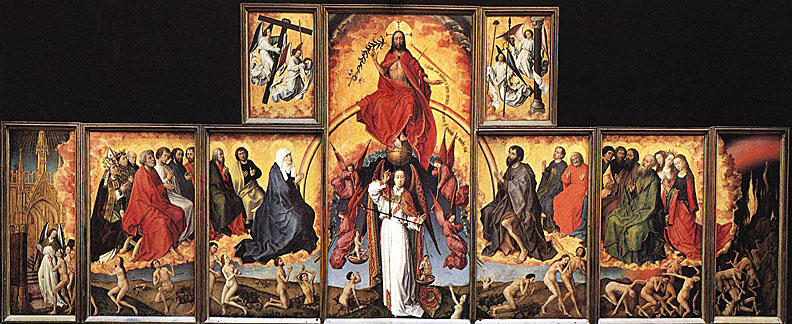
The final room I visited in the hospital housed the original version of Rogier van der Wayden's "The Last Judgement."  Different sections of the painting are opened and closed depending on the time in the church calendar.  It shows the dead rising and being judged by St. Michael, whose face is disinterested and impartial.  The good go off to the left into the shining gates of heaven.  The evil go off to the right into fire.
The sword at Jesus' left hand symbolizes justice.  Notice Saint Michael's detached gaze.  The sinners who are going off to hell on the right are depicted eating their own hands, showing the self destructive nature of sin, and pulling others into the pit to share in eternal anguish.


The people who live in Burgundy accept their buildings, art, and attitude as a way of life.  The same could be said for Americans as well.  I make no value judgments on either attitude; I'm well aware that they both have their shortcomings and their merits.  Instead, I wish to express how the attitude of a people can seep even into the buildings in which they live.

Tuesday, October 4, 2011

Opening Remarks

Truly, I've found many of the travel blogs I've read quite annoying, uninteresting and even loathsome.  There are few things more grating than someone spouting off their experiences in banal diatribes about the places they went and the things they saw without any real effort to describe their experiences or offer any more insight than I went there and did this.

Now, I'm sure that some of you who have taken the time to read this are thinking, well, he certainly wasted no time in being an ass.  Please know that it is not my goal to come off as uppity, belligerent, or pretentious--though I realize that it happens on occasion.  I simply wish to write something that will be interesting, something that will do a good job of showing what my experience is truly like and what it shows about myself or the world around me.  I'm operating under the assumption that this will be much more interesting than a simple recounting of events.

What you won't see in this blog is updates on where I am or what my plans are.  Once I figure out how this blog is laid out, I might be able to provide a separate page where I can include basic information like that.  For now, I will say that I am studying French abroad at the University of Burgundy in Dijon, France.

What you will see in this blog is my views and outlook on the events.  I will only reference to places I've gone and things I've done insofar as they help people understand what I'm talking about.  I realize that this may require quite a bit of story telling, but I want this be much more meditative in tone than narrative.  Expect a post once a week, maybe twice a week if something really important happens.

If you have questions, feel free to email me or contact me on facebook, and please please please leave comments.  I want to see what everyone thinks, and I will do my best to get back to you.  Be honest--though,  keep in mind, I will ignore asinine or short-sight comments-- as I want you to be engaged as much as I am.

Though its Monday of this week, look for the next post this coming Friday or Saturday.  Move swift like the wind; shed sight like the dawn.